
COMEDK Admission Process: Counselling Explained Step by Step
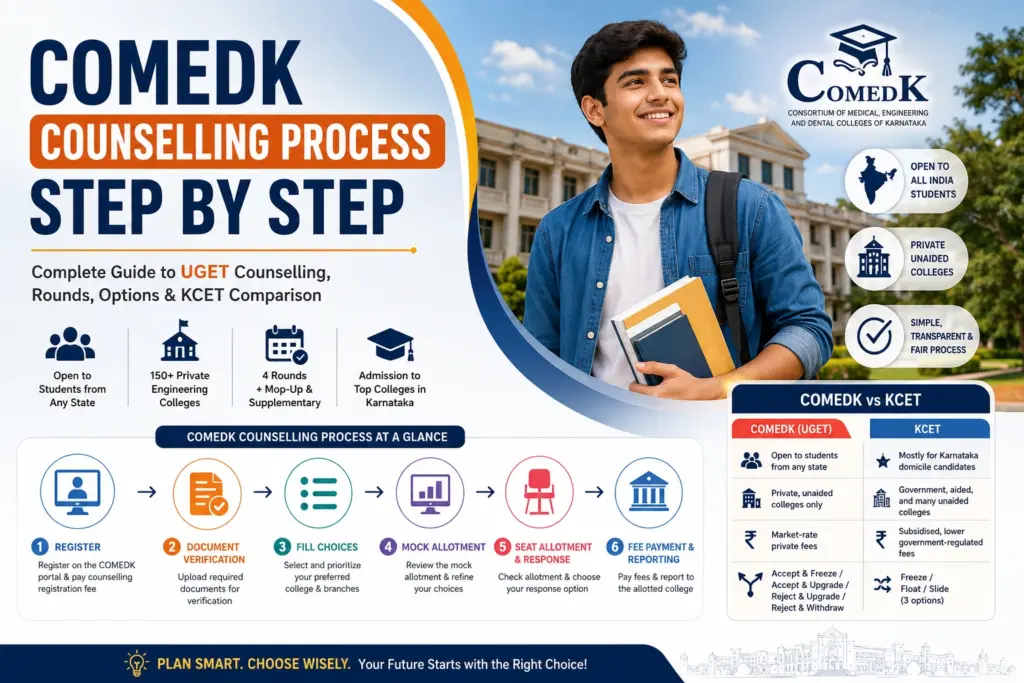
COMEDK (Consortium of Medical, Engineering and Dental Colleges of Karnataka) runs UGET, an entrance exam for admission into private engineering colleges in Karnataka open to students from any state, unlike KCET which is mostly for Karnataka-domicile candidates. Counselling runs through registration, document verification, choice filling, mock allotment, and multiple seat-allotment rounds. Full process and the KCET comparison below.
What Is COMEDK?
COMEDK stands for Consortium of Medical, Engineering and Dental Colleges of Karnataka the body that conducts UGET (Undergraduate Entrance Test) for admission to private, unaided engineering colleges across the state. Over 150 participating institutes and tens of thousands of seats run through it each year.
The one detail that trips people up most: COMEDK is not restricted to Karnataka residents. Any student who has passed 10+2 with Physics, Chemistry, and Mathematics (PCM) can apply, regardless of home state which is exactly why it exists alongside KCET rather than replacing it. KCET is largely reserved for Karnataka-domicile candidates and covers government, aided, and some unaided colleges; COMEDK covers private/unaided colleges only, open nationally.
The COMEDK Counselling Process, Step by Step
1. Register on the COMEDK counselling portal Log in at comedk.org with your UGET application number and password, and pay the counselling registration fee commonly reported around ₹2,000, non-refundable. This fee is revised each cycle, so confirm the current amount on the official portal.
2. Complete document verification Upload scanned copies of your UGET admit card, scorecard, Class 10 and 12 marksheets, and photo ID. COMEDK has largely moved to online document upload rather than an in-person centre visit, though this can vary by cycle.
3. Fill your choices (preference list) List college-and-branch combinations in strict priority order. There’s no hard cap on the number of choices, but guides commonly recommend at least 20–30 to give the algorithm enough room to work with.
4. Review the mock allotment Before Round 1 runs for real, COMEDK releases a trial allotment based on your current list and a free preview. Use the open choice-editing window afterward to reorder or add options.
5. Check your seat allotment and respond COMEDK gives you four response options after each round (see table below) different from KCET’s Freeze/Float/Slide, and worth understanding before you click anything.
6. Pay fees and report to your allotted college Once you accept a seat, pay the confirmation fee and report to the college with your documents by its deadline.
Your Response Options After Allotment
| Option | What it does |
| Accept & Freeze | Lock in this seat permanently; you exit counselling |
| Accept & Upgrade | Keep this seat for now, but stay eligible for a better one in the next round |
| Reject & Upgrade | Give up this seat, but stay in counselling for the next round |
| Reject & Withdraw | Give up this seat and exit counselling entirely |
Taking no action at all defaults to Reject & Withdraw — you’re automatically dropped from further rounds, so a non-response is the costliest mistake in this process.
How Many Rounds Does COMEDK Counselling Have?
Typically four main rounds, plus a mop-up and a supplementary round for candidates who clear PU board exams late:
- Round 1 — fills the large majority of seats
- Round 2 — for candidates who chose to upgrade, plus fresh vacancies
- Round 3 & Round 4 — further refinement as more seats free up
- Mop-Up / Supplementary Round — fills whatever remains, including for late-result candidates
After all central rounds close, any residual seats typically convert to college-level management quota, filled directly by individual colleges rather than through COMEDK’s central process.
COMEDK vs. KCET: What’s Actually Different
This is the single most-searched comparison for both exams, so here it is side by side:
| KCET | COMEDK | |
| Conducted by | Karnataka Examinations Authority (KEA) | Consortium of Medical, Engineering and Dental Colleges of Karnataka |
| Who can apply | Mostly Karnataka-domicile candidates | Students from any state |
| Colleges covered | Government, aided, and many unaided colleges | Private, unaided colleges only |
| Typical fees | Subsidised — lower, government-regulated fees | Market-rate private college fees |
| Post-allotment response | Freeze / Float / Slide (3 options) | Accept & Freeze / Accept & Upgrade / Reject & Upgrade / Reject & Withdraw (4 options) |
| Overlap | Many private colleges (e.g., RVCE, BMSCE) accept seats through both exams for different portions of their intake | Same |
A student outside Karnataka who wants a private-college seat in Bangalore generally has COMEDK as the direct route in — KCET’s Karnataka-domicile weighting makes it a harder path for non-residents.
Common Misconceptions About COMEDK
| Myth | Reality |
| “COMEDK is only for Karnataka students” | It’s open nationally — this is COMEDK’s defining difference from KCET |
| “COMEDK covers government colleges too” | No — it covers private, unaided colleges only |
| “Not responding to an allotment keeps my seat safe” | It defaults to Reject & Withdraw and drops you from further rounds |
| “COMEDK and KCET are competing for the same exact seats” | Mostly not — many colleges use them for separate seat pools, so a weak KCET rank doesn’t rule out a strong COMEDK outcome, and vice versa |
Where Does Rathinam Group of Institutions Bengaluru Fit In?
Whether you’re coming through COMEDK, KCET, or neither, it’s worth knowing Rathinam Group of Institutions Bengaluru runs its own direct admissions process rather than depending solely on either centralised counselling system:
- Minimum 50% in Class 10 and 12, with PCM (Physics, Chemistry, Mathematics) compulsory in Class 12 — no COMEDK or KCET rank requirement to apply
- B.E. in CSE and AI & ML run through Mirai School of Technology, admitting a top-12% cohort via entrance test and interview
- Remaining branches (Cyber Security, Information Science, Electronics & Communication) run through Sunstone
This makes it a useful fallback if a COMEDK or KCET round doesn’t land where you hoped — it isn’t tied to either counselling calendar, so you’re not racing the same round deadlines.
Frequently Asked Questions
COMEDK is the body that runs UGET, an entrance exam for admission to private engineering colleges in Karnataka. Unlike KCET, it’s open to students from any state, not just Karnataka residents.
The colleges are all in Karnataka, but the exam itself is open to applicants from any state in India you don’t need to be a Karnataka resident to apply.
Yes. COMEDK covers private, unaided engineering colleges exclusively. Government and government-aided colleges are covered separately through KCET.
KCET is largely for Karnataka-domicile candidates and covers government, aided, and many unaided colleges, with a Freeze/Float/Slide response system. COMEDK is open nationally, covers private colleges only, runs four main rounds, and uses an Accept/Reject + Freeze/Upgrade response system.
It’s automatically treated as Reject & Withdraw, and you’re dropped from further counselling rounds — the same as actively rejecting the seat, just without the option to upgrade later.

Mr. Raghavendra BR is a professional associated with the Training & Development Department, dedicated to enhancing students’ employability and professional skills. He focuses on providing structured training in communication, aptitude, soft skills, and industry readiness programs. His role involves guiding students through career preparation activities, workshops, and skill development sessions that bridge the gap between academics and industry expectations, helping them become confident and job-ready professionals.